
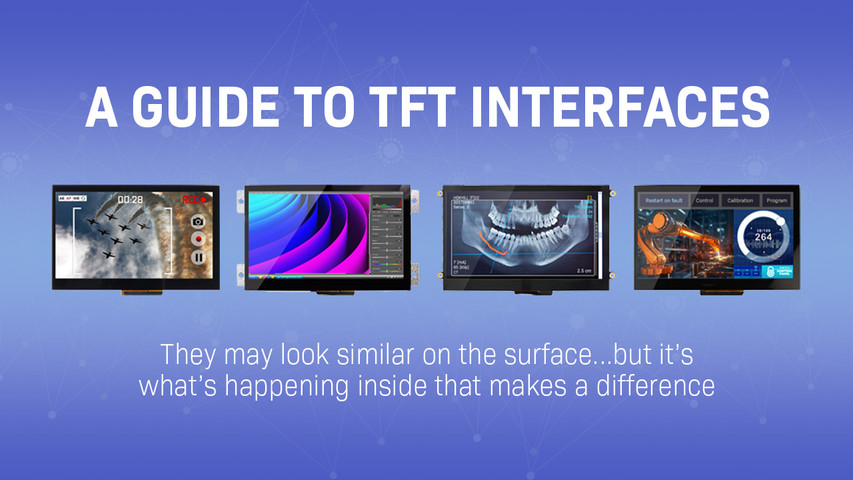
A Guide to TFT Display Interfaces
Display interfaces often get less attention than screen resolution or brightness, but they carry just as much weight in system design. They shape how a display communicates, how efficiently it moves data, and how easily it connects to the rest of the hardware. The wrong choice can create bottlenecks or delay development, while the right one streamlines both integration and performance.
Engineers working on embedded systems, industrial controls, or consumer devices benefit from knowing the strengths and limitations of each interface. A closer look at these options helps simplify the selection process and supports smarter hardware decisions.
Neste artigo:
- What is a Display Interface?
- How Interface Impact Performance, Integration & Cost
- Common Types of TFT Interface
- Choosing the Right Interface for Your Project
- Interface Integration Support from Newhaven
What is a Display Interface?
A display interface is the method used to transfer data between a controller or processor and a display module. It defines how image, color, and control signals move from the system’s core to the pixels on the screen. Each type of interface has its own format, signal timing, and hardware requirements.
In TFT displays, the interface determines how quickly and accurately the screen receives image data. It also affects the number of required connections, the complexity of the driver setup, and how much space the hardware takes on a board.
How Interface Impact Performance, Integration & Cost
The type of interface used in a TFT display influences performance, hardware compatibility, and total cost. High-speed interfaces like MIPI DSI and LVDS support smooth video and high-resolution graphics, but may require more complex hardware. Slower options like SPI or parallel are easier to work with and can be a better fit for low-power or cost-driven designs.
Some processors are designed to work with specific interfaces, which can limit flexibility. Choosing the right display interface means balancing speed and image quality against available resources and integration effort.
Common Types of TFT Interface
TFT displays use a variety of interface types to match different design needs. Some prioritize speed, while others focus on simplicity or lower pin counts. The most common options include Parallel (MCU), HDMI, MIPI DSI, SPI, RGB, and LVDS.
Each interface has unique electrical and timing characteristics that influence how the display connects and performs.
Parallel MCU Interface
How It Works
The parallel MCU interface transfers data over an 8-bit or 16-bit bus, supported by control signals like Read/Write and Chip Select. All data bits move simultaneously, which simplifies timing but increases pin count. It’s a direct connection method that works well with many microcontrollers.
Advantages of Parallel Interfaces
- Easy to integrate into embedded systems
- No high-speed signal routing needed
- Compatible with many low- to mid-resolution designs

When to Choose Parallel
Best for applications where display updates are occasional, such as control panels, simple interfaces, and handheld devices.
Newhaven Display TFTs with Parallel Interfaces
Newhaven Display offers several TFTs with 8-bit and 16-bit parallel interfaces, backed by example code, wiring diagrams, and full documentation.
Interface HDMI
How It Works
HDMI (High-Definition Multimedia Interface) carries video, audio, and control signals over a single cable. It uses differential signaling and a standardized connector, making it a plug-and-play option for many embedded and consumer systems.
Advantages of HDMI Interface
- Transmits high-resolution video and audio
- Uses a single, widely available connector
- Works with standard cables and ports

When to Choose HDMI
Ideal for designs that need to display rich media or connect to off-the-shelf devices like media players, single-board computers, or cameras.
Newhaven Display TFTs with HDMI Interface
Newhaven Display carries HDMI-compatible TFT modules built for quick integration. These displays feature onboard HDMI decoder boards and pair well with embedded platforms like Raspberry Pi.
MIPI DSI Interface
How It Works
MIPI DSI (Mobile Industry Processor Interface – Display Serial Interface) is a high-speed serial interface developed for compact devices. It transmits pixel data through differential signal pairs called lanes, allowing for fast, efficient communication using fewer pins.
Advantages of MIPI DSI Interfaces
- Enables high resolutions and fast refresh rates
- Reduces pin count and simplifies routing
- Can reduce overall power consumption compared to parallel or RGB in compact, high-data applications

When to Choose MIPI DSI
A strong choice for compact designs that require detailed graphics, smooth motion, and efficient power use. Common in wearables, portable electronics, and advanced embedded systems.
Newhaven Display TFTs with MIPI DSI Interfaces
Newhaven Display stocks MIPI DSI TFTs engineered for space-sensitive products where speed and image quality are key.
SPI Interfaces
How It Works
SPI (Serial Peripheral Interface) sends data between the display and controller one bit at a time over a few dedicated lines. It uses a master-slave setup and typically requires four connections: clock, data in, chip select, and data/command.
Advantages of SPI Interfaces
- Fewer pins required
- Simple hardware connections
- Well-suited for low-power or space-limited applications

When to Choose SPI
A good fit for displays that show static or slower-changing content. Often used in handheld devices, meters, and compact control systems.
Newhaven Display TFTs with SPI Interfaces
Newhaven Display supplies SPI-enabled TFT modules that work well in low-bandwidth systems where space and efficiency matter.
RGB Interfaces
How It Works
An RGB interface sends pixel data directly in red, green, and blue color values through parallel lines. It operates with a pixel clock and synchronization signals that control timing and image position on the screen. This method transfers complete pixel data every cycle, allowing for smooth display updates.
Advantages of RGB Interfaces
- Delivers fast, full-color image data
- Provides real-time screen updates
- Compatible with many graphic controllers

When to Choose RGB
Well-suited for applications that need fast display refresh and real-time updates, such as industrial controls, user interfaces, and media devices.
Newhaven Display TFTs with RGB Interfaces
Newhaven Display provides a variety of TFT modules with RGB interfaces, designed for applications that require responsive visuals and accurate color output.
LVDS Interfaces
How It Works
LVDS (Low-Voltage Differential Signaling) transmits data using paired signal lines that carry opposite voltages. This reduces noise and allows for high-speed data transfer over longer distances. LVDS is often used in medium to large displays where signal integrity matters.
Advantages of LVDS Interfaces
- Reliable at high data rates
- Suitable for longer cable runs
- Reduces electromagnetic interference

When to Choose LVDS
Best for displays in industrial equipment, medical devices, or automotive systems where stable, high-speed video signals are required.
Newhaven Display TFTs with LVDS Interfaces
Newhaven Display offers LVDS-capable TFT modules built for demanding applications that rely on image stability and signal consistency.
Choosing the Right Interface for Your Project
Selecting the best interface depends on the priorities of your design—speed, cost, size, compatibility, or simplicity. High-resolution displays often benefit from MIPI DSI, HDMI, or LVDS. Lower-resolution or low-power systems may be better served by SPI or parallel. RGB provides a balance of speed and simplicity for many embedded applications.
The choice also depends on what the host processor can support and how much space is available for board-level signal and cable routing. Matching the interface to the project’s performance and layout needs helps avoid integration delays and streamlines development.
Interface Integration Support from Newhaven
Choosing a display is only part of the process. Getting it to work smoothly in your system depends on the right interface, the right connections, and the right support. Newhaven Display delivers detailed documentation, wiring diagrams, and code examples that help speed up development. For more complex projects, engineers are available to assist with interface selection and integration guidance.
We also offer custom interface options on many of our displays to better align with specific system requirements. If your project requires something tailored, submit a custom display request to explore what's possible.
Partnering with a display supplier that understands embedded hardware can reduce development time and improve long-term performance. Need help choosing the right interface? Connect with our team or request a same-day quote to get started.

Últimos posts no Blog
-
A Guide to TFT Display Interfaces
Display interfaces often get less attention than screen resolution or brightness, but they carry jus …Dec 16th 2025 -
Choosing the Right Display Resolution: A User-Friendly Guide
Display resolution is one of the most defining choices in product interface design. It determines ho …Dec 11th 2025 -

Arduino vs Raspberry Pi vs BeagleBone: Key Features and Differences
If you're working on an electronics project—whether it's for a DIY automated device, a digital sign, …Dec 8th 2025